Education Technology Trends in 2026: What Is Shaping the Future of Learning
Think about how different a classroom looks today compared to five years ago.
A teacher in Bengaluru uses an AI tool to identify which students are struggling before the week is out. A medical student in Chicago practises a procedure in VR before ever entering a real operating room. A working professional in Delhi completes a certification from a global university on their phone, during their commute.
These are not future scenarios. They are happening right now. Education technology is moving faster than most educators, students, and institutions can track, and the pace is only accelerating.
This guide covers the most important EdTech trends shaping education in 2026 and beyond. Whether you are a student, a teacher, a school administrator, or someone building in the EdTech space, understanding these shifts will help you make better decisions about how you teach and learn.
Key Takeaways
- AI is the dominant EdTech trend of 2026. It has been named the #1 state education technology priority in the USA, overtaking cybersecurity for the first time.
- The use of AI in classrooms has increased sixfold since 2023, with educators reporting it saves them up to five hours of work per week.
- VR and AR are crossing from experimental to practical use in medical training, engineering, history, and corporate learning at scale.
- Hybrid and blended learning is now the default model across higher education, not a temporary pandemic measure.
- Microcredentials and digital badges are becoming a mainstream alternative to traditional degrees for career advancement.
- Digital equity remains the most urgent challenge. 258 million children globally still lack basic digital access.
- In India, EdTech is being driven by access and language inclusion. In the USA, the focus is on AI integration, personalisation, and cybersecurity.
What Are Education Technology Trends?
Tracking EdTech trends matters because the tools available to educators and learners are changing faster than institutions can keep up. The organisations that understand what is coming and prepare for it early consistently deliver better learning outcomes than those that wait.
A few years ago, the idea of a chatbot teaching an introductory university course felt like science fiction. In 2023–24, Harvard’s introductory programming course was taught by an AI chatbot, and students performed well. That is what EdTech trend acceleration looks like in practice.
The trends below are not predictions. They are developments already underway, supported by data, and gaining adoption across schools, universities, and workplaces in India, the United States, and globally.
Education Technology Trends (EdTech Trends) at a Glance
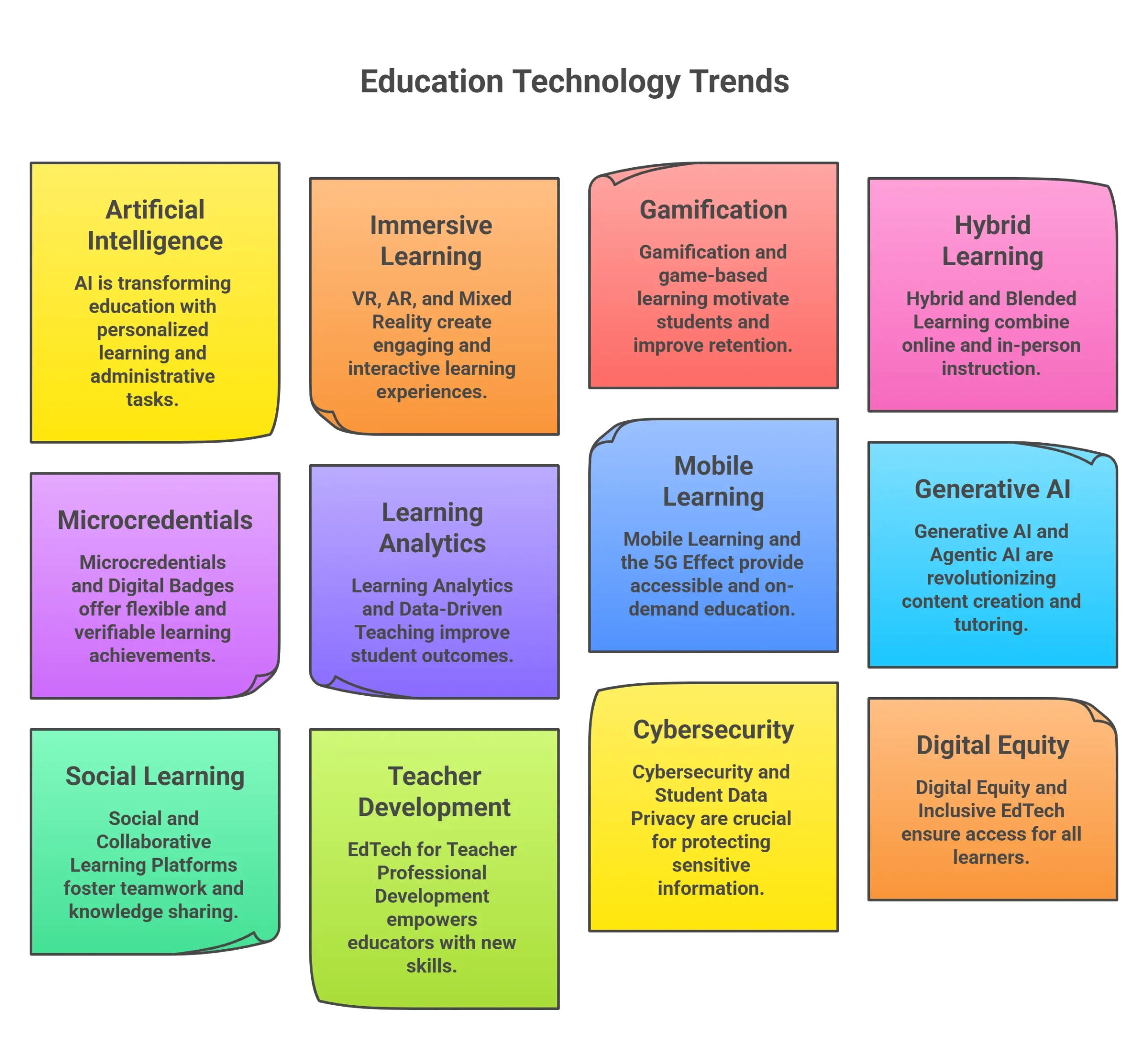
Here is a quick reference summary of all twelve trends covered in this guide:
| Trend | Current Status | Strongest Growth Area |
|---|---|---|
| AI and Personalised Learning | Mainstream rapid adoption | K-12, higher education, corporate |
| VR, AR, and Mixed Reality | Scaling — cost barriers are falling | Medical, engineering, corporate training |
| Gamification | Established — deeply embedded | K-12, language learning, compliance |
| Hybrid and Blended Learning | Default model — post-pandemic norm | Higher education and corporate |
| Microcredentials and Digital Badges | Fast-growing — employer recognition is rising | Professional and workforce learning |
| Learning Analytics | Expanding — 70% of platforms by 2026 | All sectors |
| Mobile Learning | Dominant in India and developing markets | Vernacular and rural EdTech |
| Generative and Agentic AI | Early mainstream — policies are being formed | Higher education and K-12 |
| Social and Collaborative Learning | Rebuilding learning platforms, adding social layers | Higher education and online learning |
| Teacher Professional Development | Critical gap — underfunded relative to need | All sectors |
| Cybersecurity and Data Privacy | Urgent — funding is declining as risk rises | All sectors |
| Digital Equity and Accessibility | Global priority — significant gaps remain | Rural India, developing markets globally |
Top 12 Education Technology Trends in 2026
These are the EdTech trends getting the most traction right now, backed by real adoption, real research, and real results in classrooms and training programmes worldwide.
Artificial Intelligence in Education
AI is no longer a future EdTech trend; it is the dominant force in education technology right now. According to a survey by HMH, the use of AI in classrooms has increased sixfold since 2023, with 68% of educators reporting that it saves them up to five hours of work every week.
That time saving matters enormously. When teachers spend less time on marking, lesson planning, and administrative tasks, they spend more time with students, which is where the real impact of education happens.
What AI is doing in education today
- Personalised learning paths: AI platforms like Squirrel AI and Microsoft’s Reading Coach adjust content difficulty and pacing in real time based on individual student performance, not a single class average.
- Automated grading and feedback: Objective assessments, quizzes, short answers, and code submissions are graded instantly, with explanatory feedback delivered immediately rather than days later.
- AI tutors: Conversational AI tools answer student questions at any time of day, provide worked examples, and identify gaps, functioning as a patient, always-available teaching assistant.
- Content generation for teachers: Educators use AI to generate lesson plans, differentiated worksheets, quiz questions, and rubrics in a fraction of the time these tasks previously required.
- Early intervention: AI analytics flag students who are at risk of falling behind weeks before a test, which would reveal the problem, giving teachers time to intervene proactively.
AI in education in India and the USA
Immersive Learning — VR, AR, and Mixed Reality
Virtual reality and augmented reality are crossing from classroom novelty into genuine instructional tools. The numbers reflect this shift: according to a 2023 study cited by Axon Park, VR-trained learners are 275% more confident applying new skills compared to those trained through traditional methods.
That kind of performance difference is hard to ignore, and institutions are starting to act on it.
How VR and AR are being used
- Medical and healthcare training: Nursing students practise procedures, surgeons rehearse operations, and paramedics run emergency simulations — all in VR, before they encounter these situations in real life.
- Science and history: Students walk through ancient Rome, explore the interior of a cell, or simulate chemistry experiments without physical lab equipment.
- Engineering and vocational training: Welding, electrical work, and equipment maintenance are practised in simulated environments, reducing both risk and the cost of physical materials.
- Corporate training: Companies like Walmart and Verizon have deployed VR training at scale for customer service scenarios, emergency response, and leadership skills — reporting measurably better outcomes than previous training methods.
Entry-level VR headsets now cost approximately $299, making adoption significantly more feasible for schools and training departments than even two years ago. As hardware costs continue to fall, the barrier between ‘interesting pilot’ and ‘standard classroom tool’ narrows.
AR supplements without replacing reality
Augmented reality overlays digital content onto the physical world, letting a student point a tablet at a diagram and see a 3D model emerge from the page. AR requires no headset, works on existing devices, and is increasingly built directly into educational apps and textbooks. For schools that cannot yet afford VR hardware, AR provides much of the engagement benefit at far lower cost.
Gamification and Game-Based Learning
Gamification applies game mechanics — such as points, badges, leaderboards, streaks, and rewards — to learning environments. It is one of the most consistently researched EdTech approaches, and the results are well-documented.
Students who are engaged do not just enjoy learning more; they retain more. And gamification is one of the most reliable ways to sustain that engagement, particularly for younger learners who are already fluent in the language of games.
Where gamification is working
- Duolingo: The world’s most downloaded language learning app is built entirely on gamification — streaks, leagues, and immediate reward feedback. It has been demonstrated that daily microlearning habits, when reinforced by game mechanics, produce real language acquisition at scale.
- Kahoot! and Quizlet: Live quiz competitions and flashcard games have become standard fixtures in classrooms globally, and revising feels more like a group activity than a chore.
- Corporate training: L&D teams increasingly build gamified compliance training, onboarding, and skill assessments, reducing the completion time drag that plagues traditional e-learning modules.
The key distinction worth understanding is between gamification (applying game mechanics to existing content) and game-based learning (building the learning directly into a game). Both work, but they serve different purposes and require different levels of design investment.
Hybrid and Blended Learning
When COVID-19 forced institutions online, most expected it to be temporary. It turned out to be transformative.
Students discovered they valued the flexibility of online learning, the ability to rewatch a lecture, study at their own pace, and skip the commute. Institutions discovered they could reach far more learners without the constraints of physical space. When campuses reopened, neither students nor institutions simply returned to how things were before.
How hybrid and blended learning works
- Hybrid learning: Some students attend in person while others join remotely simultaneously. This requires deliberate design to ensure the remote experience is as engaging as the in-person one, not just a passive live stream.
- Blended learning: Online and in-person instruction are combined by design, not simultaneously, but sequentially. Students might watch a video lecture at home and use class time for discussion, problem-solving, or projects.
- The flipped classroom: A specific blended model where content delivery moves home (via video) and class time becomes the space for active, teacher-guided practice. Research consistently shows stronger outcomes than traditional lecture-then-homework models.
For India, hybrid learning is particularly significant. It allows a student in a Tier-2 city to access instruction from the country’s best educators without relocating. For the USA, it is increasingly a student expectation, not just an accommodation.
Microcredentials and Digital Badges
Traditional degrees are expensive, slow, and often misaligned with what employers actually need right now. Microcredentials — short, focused, verifiable qualifications in specific skills — are filling that gap.
What makes microcredentials effective
- They are specific — a credential in Python for data analysis says something precise, unlike a broad computer science degree
- They are fast — most can be completed in weeks or months, not years
- They are verifiable — digital badges include metadata that links to evidence of achievement, which employers can check
- They are stackable — multiple microcredentials can be combined into a larger qualification over time
Key platforms
Learning Analytics and Data-Driven Teaching
Every interaction a student has on a digital learning platform generates data — on what they clicked, how long they spent on each section, where they paused a video, which questions they got wrong and how many times they retried.
Learning analytics turns that data into actionable insight. According to Axon Park, citing Gartner, 70% of EdTech platforms will integrate advanced analytics capabilities by 2026. That is not a marginal adoption; it is a fundamental shift in how educational performance is understood and improved.
What learning analytics enables
- Early identification of at-risk students: Predictive models flag learners who are showing patterns associated with dropping out or failing weeks before a crisis point, when intervention is still relatively easy.
- Content effectiveness measurement: Educators can see which lessons, videos, or assessments are working and which are not based on engagement and performance data, rather than gut feeling.
- Personalised intervention: When an analytics platform identifies a gap, it can trigger an automatic recommendation, additional practice, or a teacher alert — without waiting for the next formal assessment.
- Institutional decision-making: At the institutional level, data informs curriculum design, resource allocation, and programme effectiveness evaluation.
Mobile Learning and the 5G Effect
For much of the world, the smartphone is the primary — and sometimes only — internet-connected device. Mobile learning acknowledges this reality and designs for it deliberately.
In India, this is especially significant. With over 900 million active internet users, the majority of whom access the internet via mobile, EdTech platforms that are not mobile-first are effectively excluding a massive portion of their potential audience.
What mobile learning looks like in practice
- Short video lessons optimised for small screens and slow connections
- Offline-compatible apps that download content for use without an active internet connection
- Push notification reminders that support learning habit formation
- Voice-based interfaces that work for learners with limited literacy in the language of instruction
- WhatsApp-based learning delivery — increasingly common in India for reaching learners in Tier-3 cities and rural areas
The rollout of 5G is accelerating what is possible in mobile learning. Faster, more reliable connectivity means higher-quality video, smoother VR experiences, and real-time interactive lessons — all on a mobile device. In India, 5G coverage continues to expand rapidly into previously underserved areas, directly expanding the reach of quality digital education.
Generative AI and Agentic AI in Education
Generative AI — the technology behind ChatGPT, Gemini, and Claude — is a specific and rapidly growing subset of the broader AI-in-education trend. It deserves its own entry because its implications for education are genuinely distinct.
Traditional AI in EdTech analyses patterns and makes recommendations. Generative AI creates entirely new content — essays, practice problems, explanations, lesson plans, code, and even simulated conversations — on demand.
How generative AI is being used in education
- For students: Instant explanations of difficult concepts, worked examples on demand, writing feedback, language translation, and study guides created from their own notes
- For teachers: Lesson plan generation, differentiated worksheet creation, rubric design, parent communication drafts, and assessment question banks
- For institutions: Chatbots for student enquiries, automated admissions responses, and personalised onboarding communications
The emerging challenge: AI and academic integrity
Generative AI creates a genuine tension in education. The same tool that can help a struggling student understand a concept can also write that student’s essay for them. Institutions are actively developing policies, detection approaches, and assignment redesigns to address this, but there is no simple, universal solution.
The more productive long-term response is shifting assessments toward tasks that AI cannot easily replicate: oral presentations, live problem-solving, project-based work, and demonstrations of applied skill. Generative AI is forcing education to ask what human learning is actually for, and that is not a bad question to be asking.
Social and Collaborative Learning Platforms
Learning is social. People learn from each other through discussion, debate, peer feedback, and shared problem-solving. Traditional e-learning often strips this social dimension out entirely, replacing it with passive video watching. That approach consistently shows weaker outcomes.
Newer EdTech platforms are deliberately rebuilding the social layer of learning. Features like peer discussion boards, collaborative documents, breakout group tools, shared annotation, and community forums recreate — at least partially — the learning that happens between people, not just from content.
What collaborative EdTech looks like
- Collaborative platforms: Google Workspace for Education and Microsoft Teams allow students to co-create documents, give each other feedback, and work on group projects in real time, regardless of where they are physically located.
- Peer learning communities: Platforms like Slack, Discord, and dedicated learning communities enable learners to form study groups, ask questions, and share resources in a format that mirrors how they already communicate digitally.
- Social learning apps: Some EdTech platforms are explicitly building in social features — leaderboards, challenges between friends, shared progress milestones — to harness the motivational power of learning alongside others.
EdTech for Teacher Professional Development
Technology in education is only as effective as the educators using it. A school that deploys AI tools without training its teachers to use them well will see poor results — not because the tools fail, but because implementation without support almost always does.
This is one of the most consistent findings in EdTech research and one of the most consistently under-addressed in practice.
The training gap
According to HMH’s annual survey, 36% of educators have received no training in AI, and 54% have received only limited training. Despite AI being the #1 EdTech priority in the USA, the majority of teachers are navigating it without meaningful institutional support.
How EdTech is addressing this
- Online professional development platforms — including Google for Education, Microsoft Educator Centre, and DIKSHA in India — offer free, self-paced training in digital tools and pedagogical approaches
- Peer-led learning models, where experienced teachers lead AI training workshops for colleagues, are showing stronger adoption results than top-down institutional programmes
- Microcredentials specifically designed for educators — covering AI literacy, data interpretation, and blended learning design — are growing rapidly as a teacher upskilling category
- States like Nebraska, Wyoming, and North Carolina in the USA have built structured programmes that compensate teachers for developing and leading peer AI training
Cybersecurity and Student Data Privacy
Every EdTech trend on this list generates more data. AI personalisation requires detailed student behaviour data. Analytics platforms track every interaction. Gamification systems log every attempt and every failure. That data is enormously valuable for improving learning — and enormously sensitive when it involves children.
Cybersecurity in EdTech is not a separate concern from these other trends. It is the foundation that makes all of them trustworthy.
Why this is urgent
- More than three out of four US states have either adopted device restrictions or are actively considering them, partly driven by data privacy concerns alongside mental health considerations
- States reporting very little cybersecurity funding more than doubled from 17% in 2024 to 35% in 2026, even as the data schools collect becomes more extensive
- Student data breaches have real consequences: leaked performance records, family information, and behavioural patterns can affect students’ futures in ways that are very difficult to reverse
What good cybersecurity practice looks like in EdTech
- Selecting platforms that comply with relevant data protection laws — FERPA and COPPA in the USA; the IT Act and DPDPA 2023 in India
- Giving parents and students clear visibility into what data is collected and how it is used
- Ensuring data minimisation — collecting only what is needed for a specific educational purpose, not a broader commercial one
- Building multi-factor authentication and regular security audits into school technology infrastructure
Digital Equity and Inclusive EdTech
Every trend in this article depends on one thing: access. Access to devices. Access to the internet. Access to electricity. Access to a quiet place to learn.
This is the EdTech trend that most urgently needs to be a priority and is most often left for last.
What is being done
- USA: The FCC launched a $42.5 billion initiative in 2023 to connect rural schools. The E-Rate programme continues to subsidise broadband for schools and libraries. Digital citizenship education — teaching students to use technology responsibly — is now being implemented in 60% of states.
- India: The PM eVIDYA initiative, DIKSHA platform, and Udyam broadband expansion are working to extend digital learning infrastructure to rural and remote areas. Vernacular content in Hindi, Tamil, Telugu, Bengali, and other regional languages is expanding to reach India’s next 500 million learners.
- Globally: Offline-compatible apps, low-data video formats, and solar-powered device programmes are being deployed in areas without reliable electricity or internet connectivity.
Conclusion
The education technology trends of 2026 are not just incremental upgrades to existing tools. Several of them — such as AI personalisation, immersive learning, generative AI, and predictive analytics — represent genuinely new capabilities that change what is possible in education.
At the same time, the fundamentals have not changed. Students learn best when they are engaged, supported, and taught by people who understand their needs. Technology accelerates and amplifies what good teaching already does; it does not replace the human work at the centre of education.
For India, the most transformative trends are mobile learning, vernacular AI, and the government-backed expansion of digital infrastructure — because these unlock quality education for learners who previously had no access to it.
For the USA, the focus is on making AI adoption thoughtful and equitable, ensuring the benefits of personalisation and efficiency reach every student, not just those in well-funded districts.
Globally, the EdTech trends that will matter most are the ones that are both powerful and accessible. Because the most sophisticated learning technology in the world is only transformative if the learners who need it most can actually reach it.
Frequently Asked Questions About EdTech Trends
Artificial intelligence is the dominant EdTech trend in 2026. AI has been named the #1 state education technology priority in the USA for the first time, overtaking cybersecurity. The use of AI in classrooms has increased sixfold since 2023, and it is reshaping personalised learning, automated grading, teacher support, and student feedback across every level of education.
The new technologies in education seeing the widest adoption in 2026 are AI-powered personalised learning platforms, VR and AR immersive learning tools, learning analytics dashboards, generative AI tools for both students and teachers, and collaborative digital learning environments. Mobile learning platforms are also expanding rapidly, particularly in India and other mobile-first markets.
AI is changing education in several significant ways: it personalises learning to each student’s pace and level; it provides instant, detailed feedback on assignments; it flags students who are at risk of falling behind before they fail; it saves teachers hours of administrative time each week; and it powers AI tutors that are available 24/7. At the same time, AI raises important questions about academic integrity, data privacy, and equitable access.
VR (virtual reality) in education allows students to learn through immersive, simulated experiences that are difficult or impossible to replicate in a traditional classroom. Medical students practise procedures, history students walk through ancient civilisations, and engineering students handle virtual equipment. Research shows VR-trained learners are 275% more confident applying new skills compared to those trained traditionally. Entry-level VR headsets now cost around $299, making broader adoption increasingly practical.
EdTech trends in India are shaped by the need for scale, language diversity, and mobile-first access. Key trends include vernacular AI platforms building content in Hindi, Tamil, Telugu, and other regional languages; mobile learning optimised for lower-bandwidth connections; government initiatives like PM eVIDYA and DIKSHA expanding digital infrastructure to rural areas; and homegrown platforms like PhysicsWallah and upGrad making quality education affordable for students far beyond major cities.
Microcredentials are short, focused, verifiable qualifications that certify a specific skill or competency. They are growing because they are faster and cheaper than traditional degrees, more precisely aligned with what employers actually need, and increasingly recognised by companies as legitimate proof of skill. Platforms issued 36 million digital credentials in 2024, a 45% increase from the previous year, reflecting how rapidly this format is gaining acceptance in both education and hiring.
Learning analytics is the collection and analysis of data generated by students interacting with digital learning platforms — such as what they clicked, how long they spent on a lesson, and which questions they answered correctly or incorrectly. Educators use this data to identify struggling students early, measure which content is most effective, personalise support, and improve curriculum design. Gartner projects that 70% of EdTech platforms will integrate advanced analytics by 2026.
The biggest challenges facing EdTech in 2026 are the digital divide (258 million children globally still lack basic digital access), insufficient teacher training to use new tools effectively, data privacy and cybersecurity concerns as platforms collect more student data, the risk of AI tools enabling academic dishonesty, and the persistent risk that the most powerful EdTech tools will benefit already-advantaged students while leaving the most disadvantaged further behind.